Read Time:
5-minute
article
Will your retirement income keep up with inflation?
This content is categorized as:
Everyone feels the effects of inflation. It’s unavoidable when buying groceries, paying a medical bill, picking up household goods, buying a car or purchasing plane tickets for vacation. Even though the impact on your purchasing power is obvious, the concept itself can sometimes feel unclear.
Inflation1 is the gradual rise in prices for goods and services over time. The inflation rate is the percentage change year-over-year.2 As it increases, every dollar you’ve saved buys a little bit less.
Most people first take notice of inflation when shopping. It’s simple to see when you’re spending more on grocery runs or filling up your gas tank. But inflation’s long-term effects run deeper and can be less obvious — especially when it comes to retirement planning. For many retirees, their income will need to keep up with 20, 25 or 30 years of rising prices.
What is inflation and why does it matter?
Inflation reflects overall price increases, but specific categories don’t move in sync. The cost of healthcare, education and household goods can rise at different rates. For example, a temporary shortage or supply chain disruption can result in a price spike. A specific product can become expensive due to drought or a factory closure that causes a short-term supply issue. Inflation is broader and more sustained.
Historically, the U.S. has seen an average inflation rate of about 2% to 3% per year2. But most people feel inflation long before they see the data. Consider that, because of inflation, an item that cost $10 in 2015 costs about $13.60 in 20253,4. A practical example would be a gallon of milk: it averaged $3.40 in 2015 but can cost around $4.205 in 2025. Again, prices vary depending on supply, demand, location and even climate events.
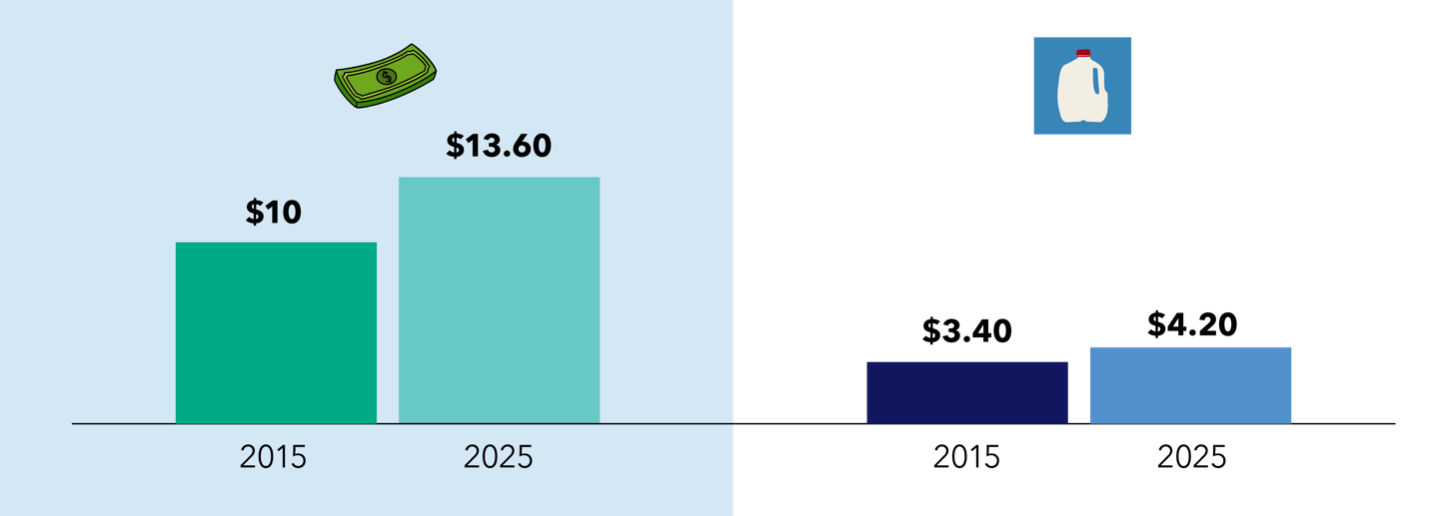
These examples may seem insignificant, but they add up over decades when you’re measuring its effect on retirement income. Over such a long time horizon, even moderate inflation can reshape your budget.
And for retirees on fixed incomes, inflation can truly be a game changer. If inflation averages 3% annually, a retiree starting with $70,000 in yearly income would need more than $140,000 after 25 years to maintain the same lifestyle6. That’s why planning for “inflation-adjusted income” matters: long-term costs grow faster than many people expect.
But there are helpful strategies and tools designed to help protect your purchasing power.
Making your money last through retirement
Saving and investing are essential, but those things alone may not keep pace with rising prices. The real challenge is ensuring your money continues to grow after you retire.
Cash inevitably loses purchasing power over time. But even low-yield bonds often fail to keep up with inflation. That’s why a diversified retirement plan is important. It can blend steady, predictable income with assets that can outpace inflation. And that’s where annuities may come in. Annuities are designed to provide stable, reliable income throughout retirement.
Different types of annuities offer a range of benefits depending on your goals. And they can complement existing portfolio assets and help bring some peace of mind during volatile or high-inflation time periods.
Annuities can fit into any retirement plan
An annuity allows you to contribute money either as a lump sum or over time. In return, you receive income later. Depending on the type you choose, income can start immediately or at a future date, even lasting for life.
Annuities aren’t intended to replace your investment portfolio. Instead, they can enhance it. With annuity income, you may even choose to stay invested longer in certain markets, giving your money a chance to grow.
They can also help protect your income against inflation. They grow tax-deferred, meaning your income potential increases over time. And certain annuities, such as Fixed indexed annuities (FIAs), link their growth to the performance of a market index. Some annuities also offer features like an annual automatic increase, which automatically increases the income payment you receive each year. While they don’t promise exact inflation matching, they can help your income rise gradually to potentially help offset inflation’s impact.
Having multiple income sources and a smart tax deferral strategy can be key to finding balance in your retirement plan.
The potential for stability
If you’re in your 40s or 50s, there’s plenty of time to refine or adjust your retirement strategy to account for inflation. You may be supporting kids, helping aging parents and saving for retirement all at once. You may even be able to see how far your parents’ retirement dollars stretch — which can be both eye-opening and motivating.
But as you draw closer to retirement, market swings can start to take on greater impact. Annuities can offer stability in an unpredictable environment and help ensure your money goes further.
Preparation matters more than prediction
No one can forecast inflation perfectly. But with the right planning and help from a financial professional, you can build a strategy that works for you and protects your purchasing power over time.
Diversifying your income sources with tools like annuities can help keep your retirement plans in line with rising costs. Small steps today can build financial confidence that stays intact for the long haul.
Learn how annuities can help protect your retirement income from inflation. Explore your options today.
Want the most from your retirement? Get smarter with Smart Strategies from Athene. Your source for tips, tools and financial solutions that can help you live your best life.
1 International Monetary Fund, 2025, Inflation: Prices on the Rise
2 Investopedia, 2025, Inflation rates year over year
3 Bureau of Labor Statistics, 2025, CPI Calculator.
4 Federal Reserve Bank of Minneapolis, 2025, Inflation Calculator
5 FRED, 2025, Average price of Milk in U.S. Cities
6 Center for Retirement Research, 2024, How does inflation impact near retirees.
Under current tax law, the Internal Revenue Code already provides tax deferral to qualified money, so there is no additional tax benefit obtained by funding a qualified contract, such as an IRA, with an annuity; consider the other benefits provided by an annuity, such as lifetime income and a Death Benefit.
