Understanding the tax and planning implications of Roth IRA conversions
This content is categorized as:By Jay Kautt, VP of Advanced Market Sales at Athene
Roth IRA conversions are a popular strategy for high-income earners looking to maximize their retirement savings. In my previous article, I discussed the benefits of Roth conversions as a strategy that may help manage tax liability.
It's important to understand the nuances of Roth conversions, including the fact that income tax is due on the converted amount the year in which the conversion is made. Additional considerations include the pro-rata rule and the Roth IRA 5-year rules.
Backdoor Roth IRA strategy and pro-rata rule implications
The backdoor Roth IRA is a strategy — it is not a product or a different type of Roth IRA. It allows individuals who exceed Roth IRA contribution limits to convert dollars instead of making a direct contribution.
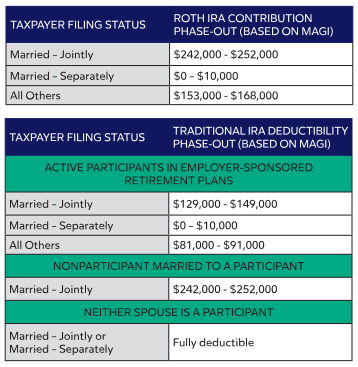
The taxpayer makes a non-deductible contribution to a traditional IRA and then converts those funds to a Roth IRA. That sounds simple enough. But there’s more to it. Taxpayers and financial professionals need to be aware of the pro-rata rule.
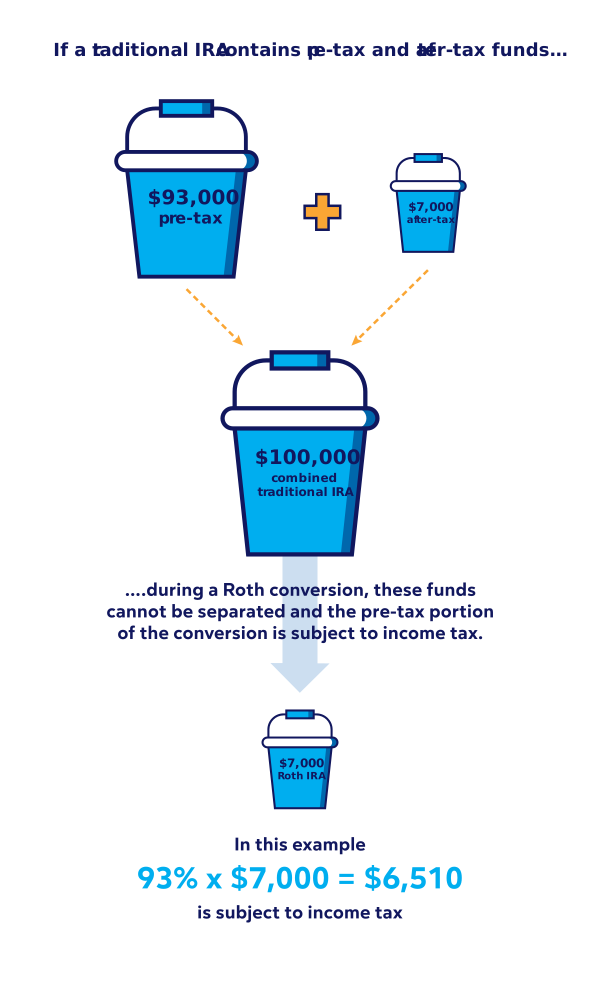
The IRS treats all dollars in a taxpayer’s IRA as one bucket of money for purposes of Roth conversions. Taxpayers are not allowed to separate or isolate pre-tax and after-tax dollars for Roth conversion purposes. Here’s a scenario to explain the pro-rata rule in terms of a backdoor Roth IRA strategy.
A client has income that exceeds the Roth IRA contribution limit. They have $93,000 in a traditional IRA that was a rollover from an old 401(k), so it’s pre-tax money. The client makes a $7,000 non-deductible traditional IRA contribution with the intent of converting that $7,000 to a Roth IRA. The pro-rata rule prevents this client from isolating the $7,000 of after-tax money when making the conversion. They now have $100,000 of total IRA money — $93,000 of which is pre-tax. Therefore, when converting the $7,000, 93% of the $7,000 ($6,510) is subject to income tax.
Other factors to know: Roth IRA 5-year rules
Two separate, distinct 5-year rules that govern distributions from Roth IRAs
- 5-year rule #1 – Applies to converted amounts only and to taxpayers under the age of 59½. This rule exclusively deals with the 10% penalty.
- 5-year rule #2 – Applies specifically to qualified tax-free distributions from a Roth IRA.
The first 5-year rule requires that an individual holds converted dollars for five years OR they are at least age 59½ to withdraw funds free of the 10% penalty. This rule is in place to prevent those under age 59½ from “beating the IRS” out of the 10% penalty by simply converting their traditional IRA dollars to a Roth IRA.
Age 59½ is a hard cutoff for this rule because a taxpayer could withdraw money from their traditional IRA free of penalty when they attain this age. Each conversion has its own separate holding period beginning on January 1 of the year the conversion was made. Remember, when withdrawing money from a Roth IRA, contributions come out first, then converted amounts and finally, earnings.
The second 5-year rule applies to tax-free qualified distributions from a Roth IRA. This is sometimes referred to as the “forever” 5-year rule. An individual must have funds in a Roth IRA for five years AND reach age 59½ to withdraw the earnings free of income tax. The 5-year holding period begins on January 1 of the year the first Roth IRA is established by the taxpayer and this clock DOES NOT restart with each subsequent contribution or conversion. There are exceptions to the age 59½ requirement: death, disability or a first-time home purchase (up to a $10,000 limit).
Is a Roth IRA conversion right for your client?
Remember, a Roth conversion is not an all or nothing scenario. Clients can execute partial Roth conversions. A partial Roth conversion allows individuals to potentially manage their tax brackets and plan for future tax rates. Financial professionals should work closely with their clients to discuss the pros and cons of Roth conversions, including the tax obligation, for their specific situation.
Roth IRA conversions can be a powerful tool for tax planning and maximizing retirement savings. An understanding of the backdoor Roth IRA, the pro-rata rule and the Roth IRA 5-year rules are essential to assist clients in making an informed decision.
Roth IRA conversion rules you should know
Get expert insights on conversions, the pro-rata rule and 5-year timing rules.
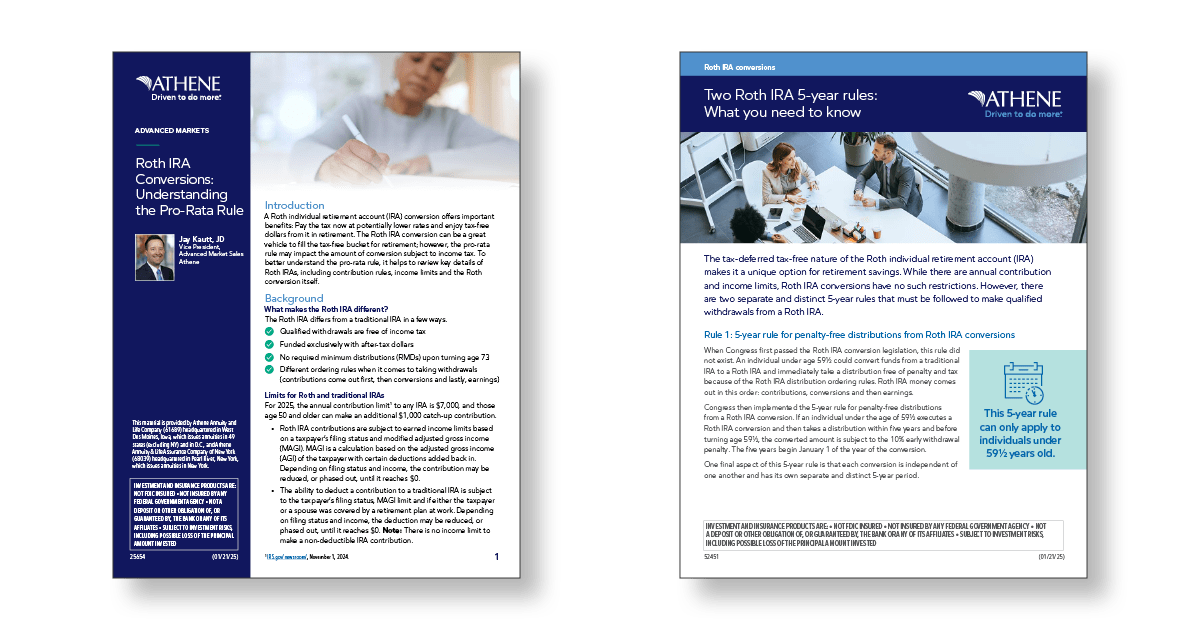
Insights on Athene Connect. Tips, tools and resources to grow your business by helping clients retire with confidence.
Any information regarding taxation contained herein is based on our understanding of current tax law, which is subject to change and differing interpretations. This information should not be relied on as tax, legal or financial advice and cannot be used by any taxpayer for the purposes of avoiding penalties under the Internal Revenue Code. We recommend that taxpayers consult with their tax or legal professionals for applicability to their personal circumstances.